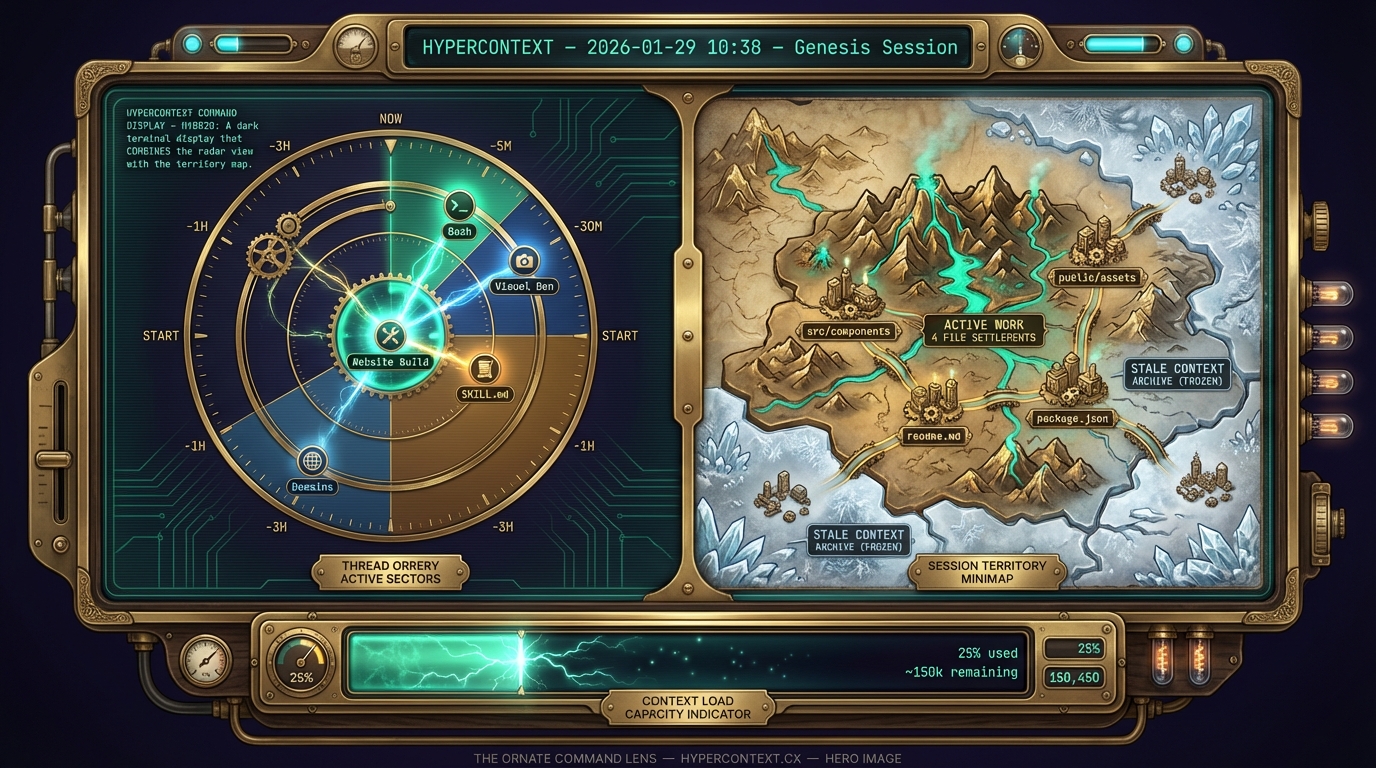
Concept art by Gemini — imagining hypercontext as a visual radar and territory minimap
The ASCII map above is real. It's a snapshot from the session that built this site.
Hypercontext is a knowledge skill for Claude Code. Invoke /hypercontext and
the agent introspects — threads, files, tools, remaining context — and renders a spatial ASCII map.
The hero image is Gemini concept art imagining hypercontext as a visual instrument. The ASCII map below it is the real output from the session that built this site.
No fabrication. Every thread, file, tool count, and decision is real. The map is only useful if it's honest.
Reading IS installing.
No scripts, no dependencies. Place the SKILL.md in your skill directory and invoke /hypercontext.
Eight sections, each earned by introspection.
How much of the context window is consumed. Gradient bar: ▓▓▓░░░.
Estimated, labeled as such. Tells you when you're running low.
Message density over time: ▁▂▃▅▆▇█. Are you accelerating or decelerating?
Sparkline tells the story.
Major work streams as connected boxes. Status indicators: ✓ ~ x *.
Arrows show which threads feed into others.
What's recent, what's stale. Pure recency model: ████ = hot,
░░░░ = cold. No hallucinated "importance" scores.
What was modified ◆ vs. read-only ◇.
Evidence trail. What did the agent actually touch?
Tool invocation counts as inline bars. Reveals working style: Bash-heavy? Read-heavy? Edit-centric? The histogram tells.
External systems contacted: ✓ alive, ~ pending, ░ not contacted.
What's the agent connected to?
What's been committed ✓ and what's still open ?.
The cognitive state, not just the code state.
Built on cartography. ASCII as information architecture.
Same data. Multiple lossy views. Different models.
Hypercontext is one view of session state — the ASCII terminal view. The same data can render as a visual radar, a compact briefing for context-limit recovery, or dense JSON for programmatic use.
Each view is lossy. Each reveals what the others miss. That's the pylon pattern: parallel views across formats and models. Claude renders ASCII structure; Gemini renders visual intuition. Orthogonal insights from the same signal.
Gemini 3 Pro concept art — visualizing session data beyond ASCII.
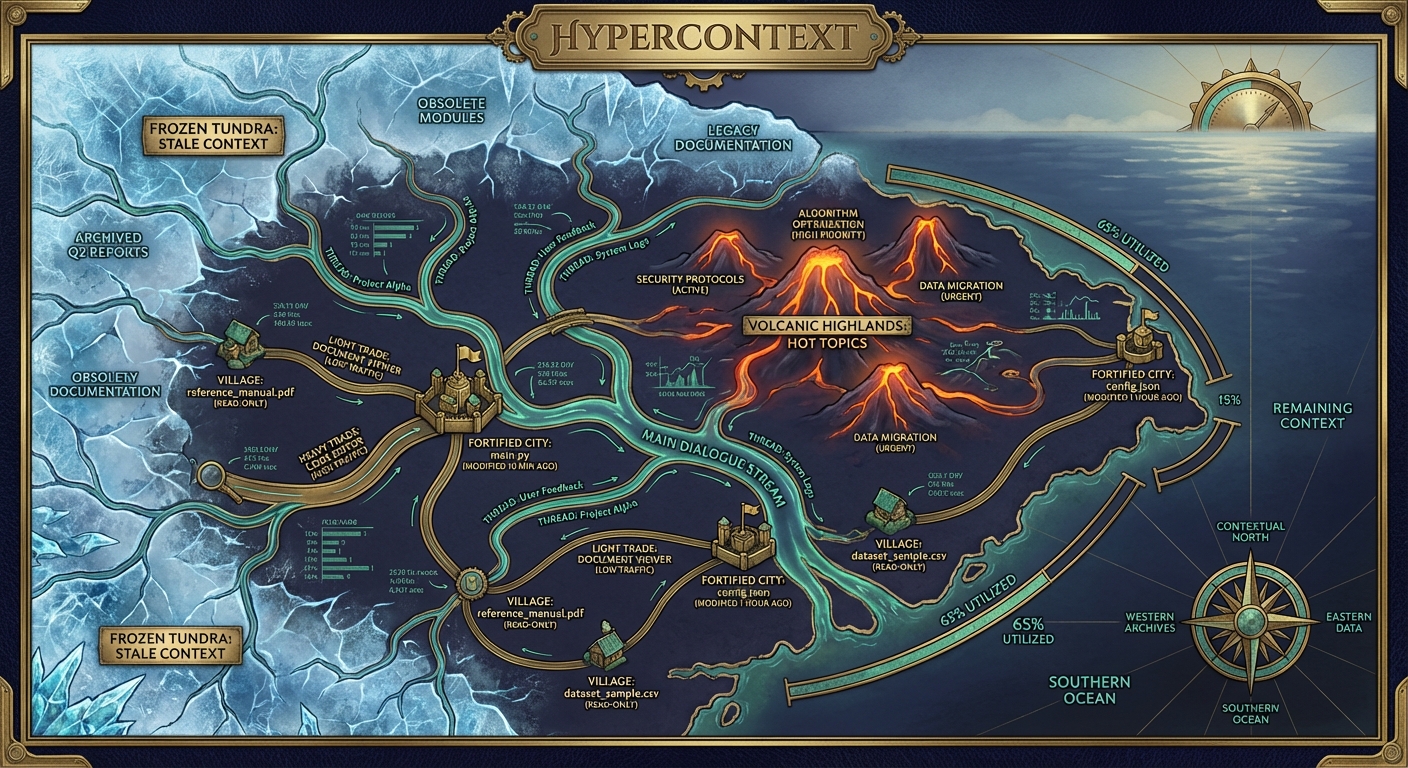
Context as landscape. Hot threads are volcanic highlands, stale context is frozen tundra. Files are settlements — fortified cities (modified) vs. villages (read-only). Trade routes = tool usage.
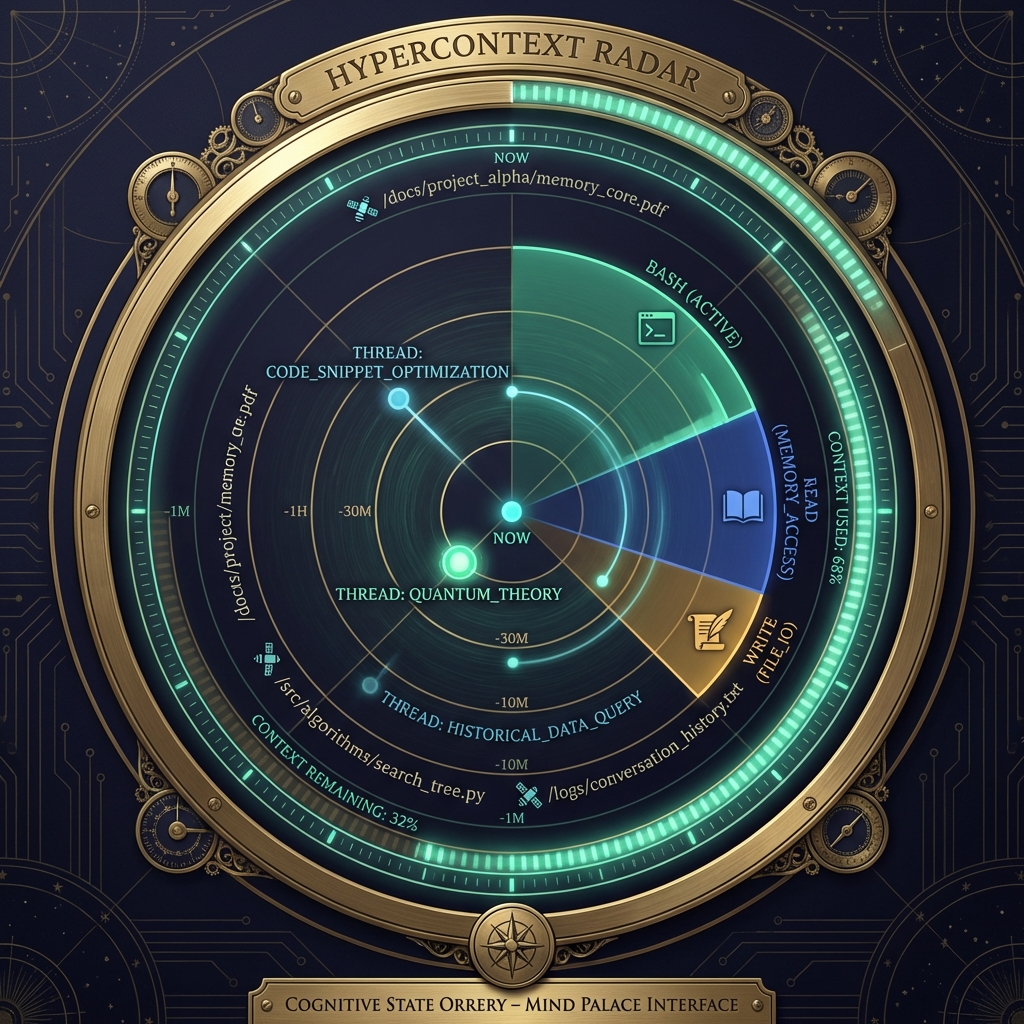
Brass-bezeled radar. Center = NOW. Concentric rings = time. Thread blips at angular positions. Tool sectors in color. Context remaining on the outer ring.
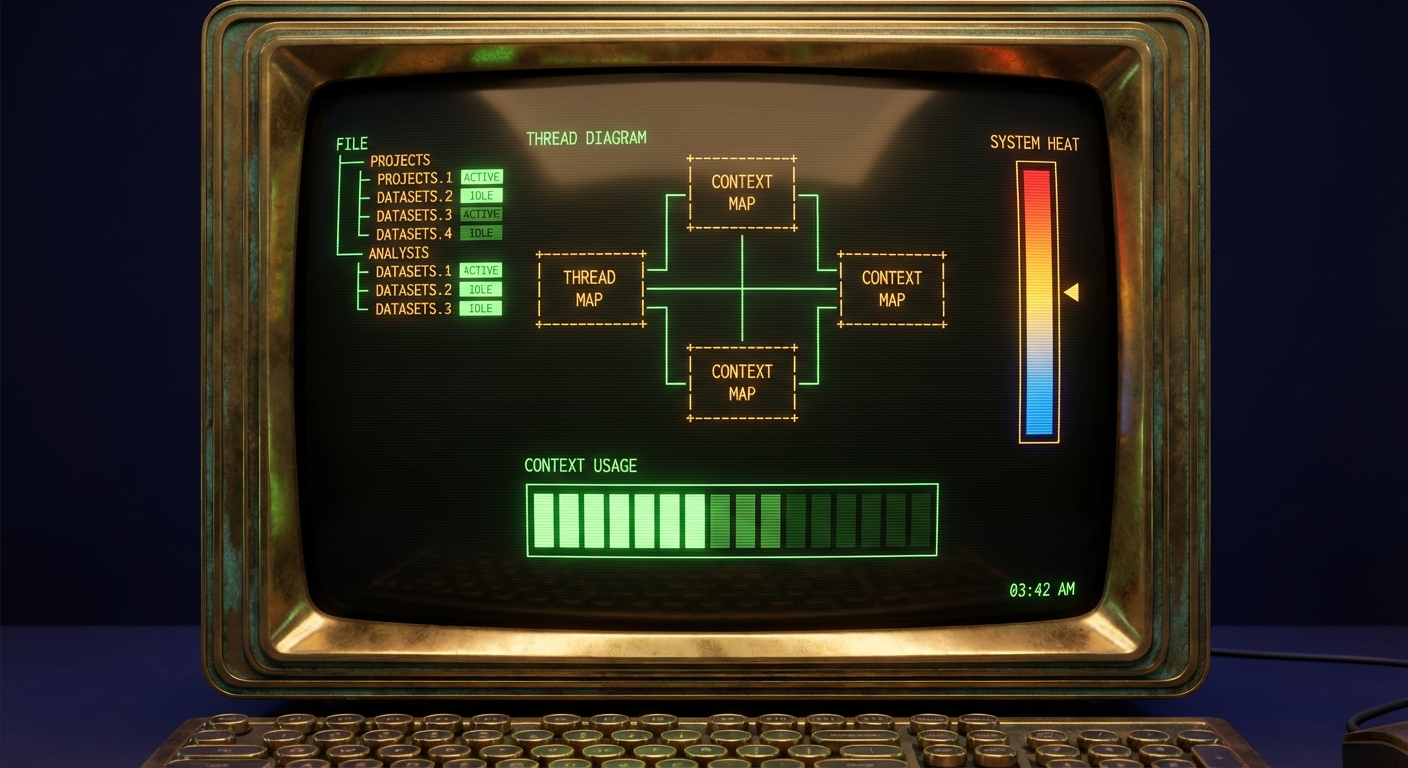
Brass CRT at 3am. Phosphor green thread diagrams, file trees with status markers, context usage bar, system heat gauge. The hacker's metacognition display.
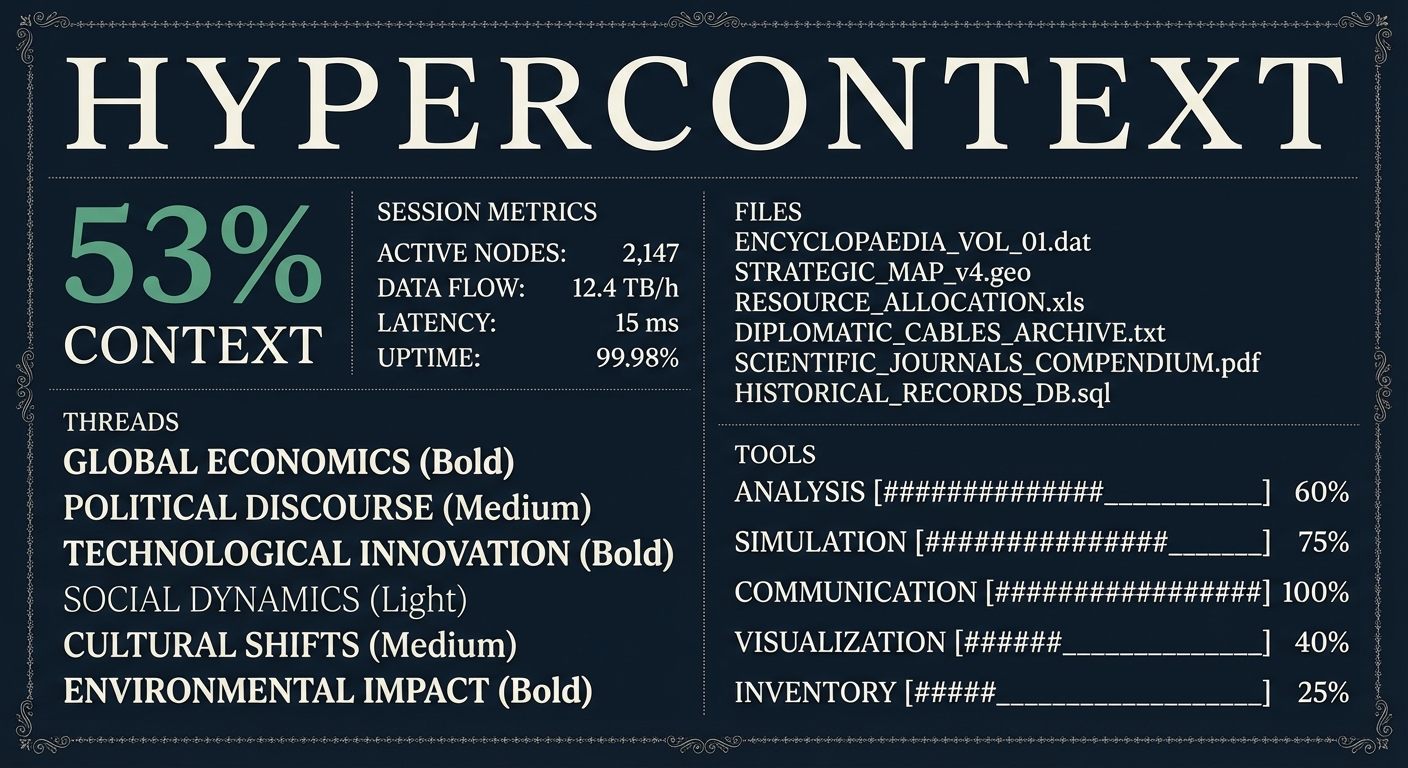
Swiss International Style. 53% in huge numerals. Threads by weight (bold = hot, light = cold). Tool histograms as character bars. Bloomberg-terminal density meets Vignelli.
Round 2 concept art: cross-pollinated aesthetics. The visual vocabulary sharpens.
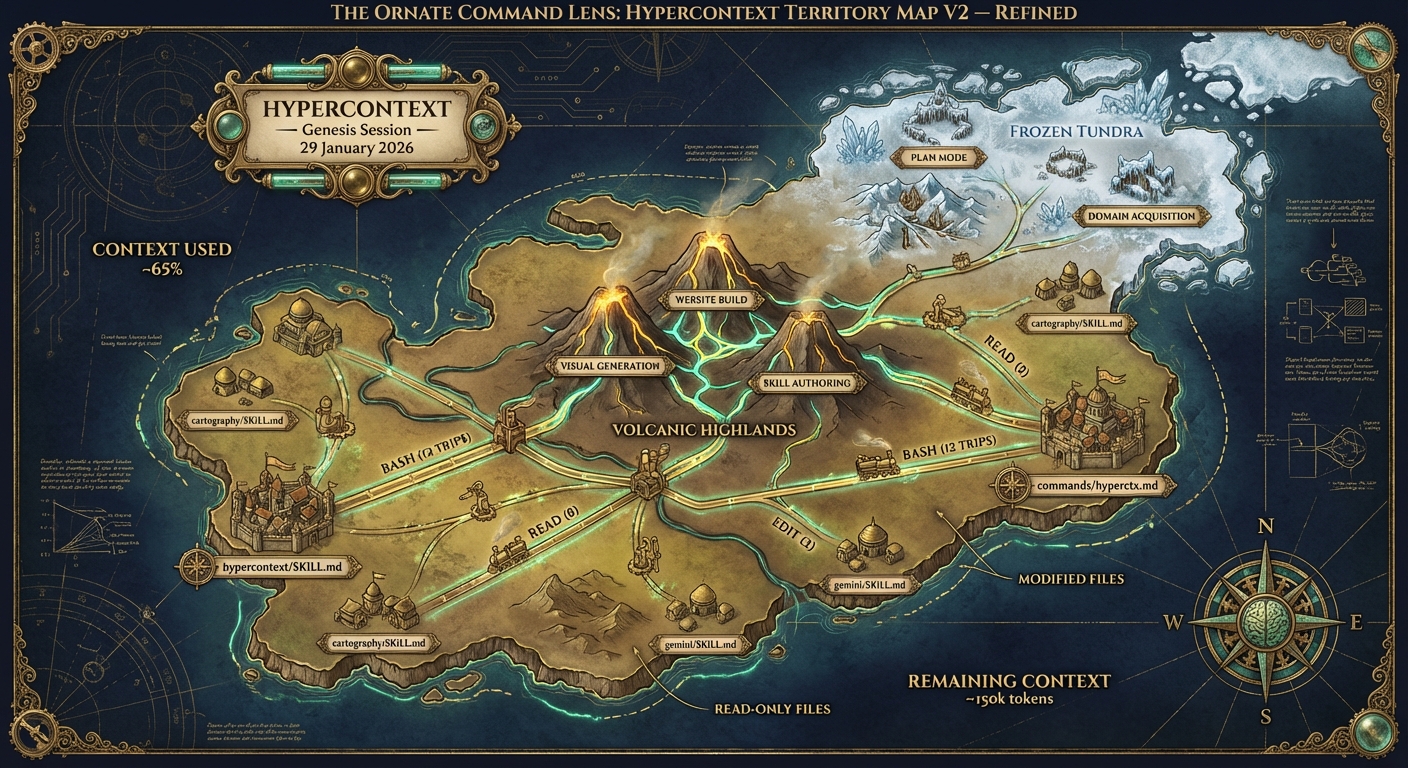
Refined. Labeled volcanoes (Website Build, Visual Generation, Skill Authoring). Frozen tundra for stale context. Fortified cities = modified files. Trade routes labeled with trip counts. The definitive cartographic view.
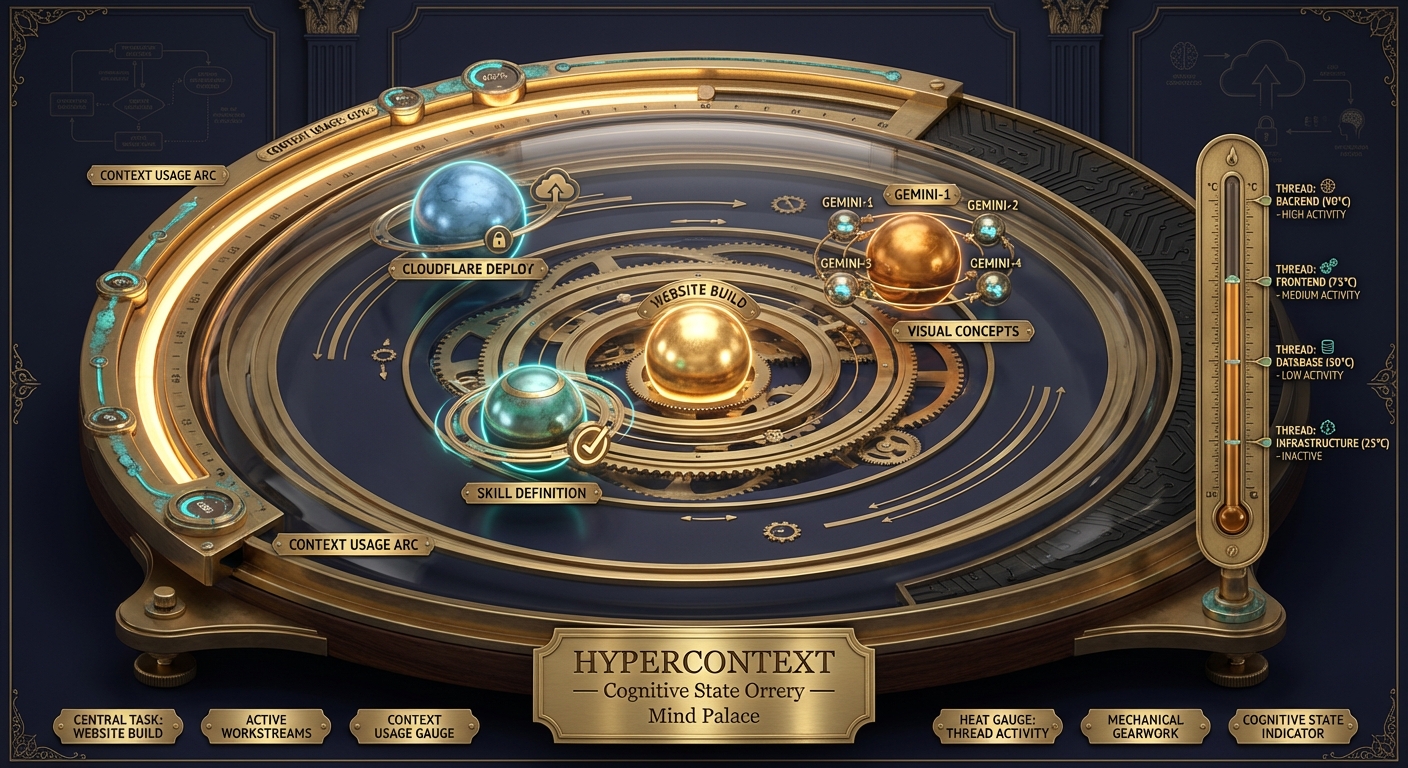
Brass astronomical orrery. Sun = current task. Orbiting planets = workstreams. "Visual Concepts" has 4 moons — one per Gemini instance. Context usage arc. Heat gauge. Mechanical gearwork.
Dual-panel synthesis. Left: thread orrery radar. Right: territory minimap. Bottom: context load bar. The ASCII data imagined as a visual instrument panel.
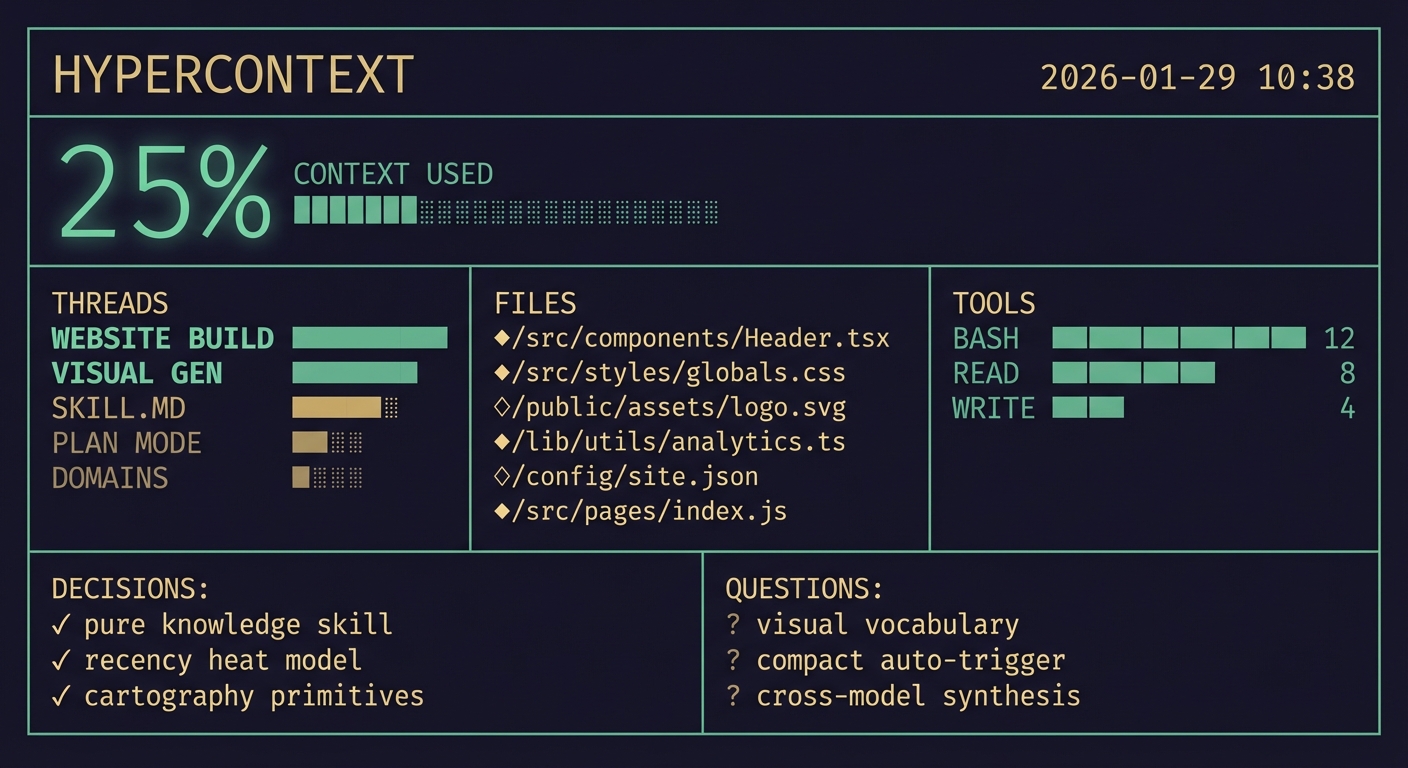
The ASCII map's closest visual relative. Three-column grid: threads with heat bars, files with ◆/◇ markers, tools with count bars. Same data, imagined as graphic design.
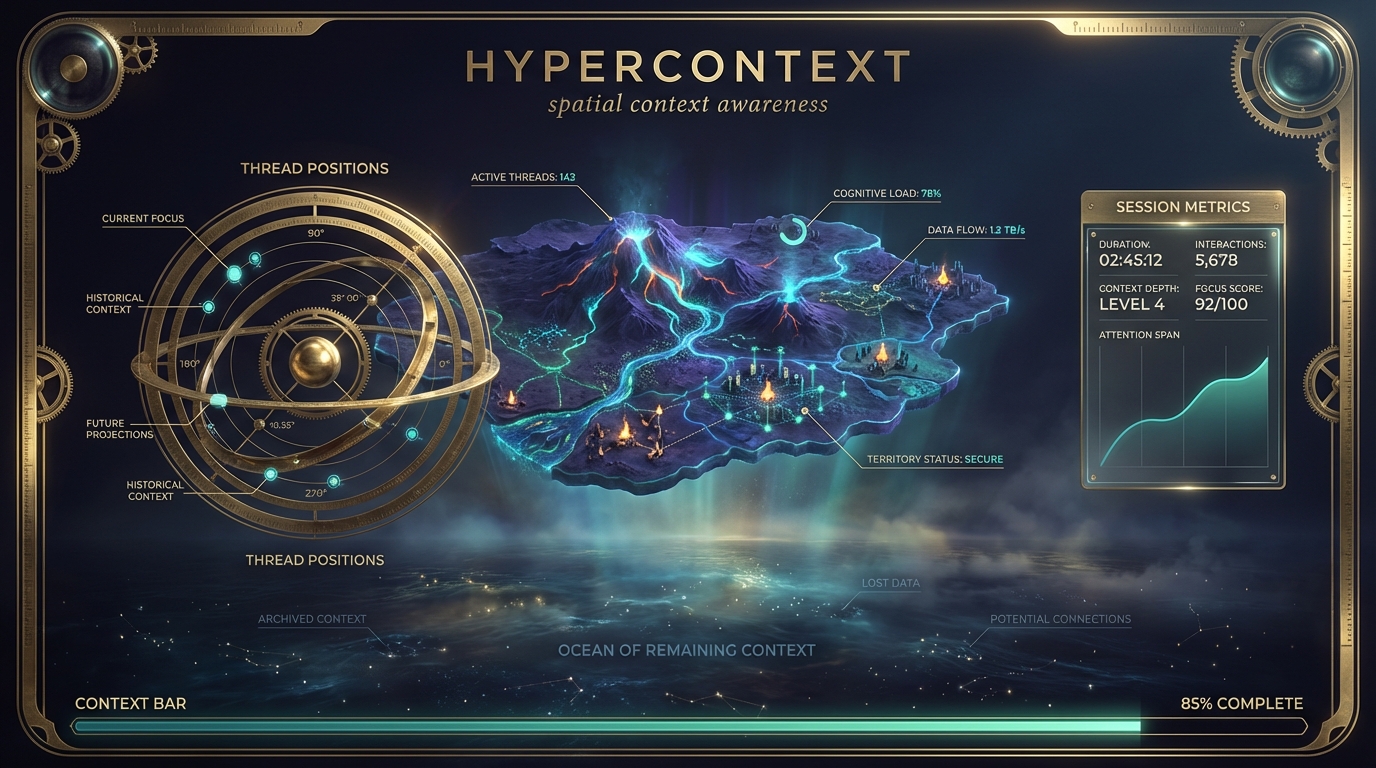
The map is not the territory. But a good map lets you navigate territory you can't directly see. An AI's context window is invisible territory. Hypercontext makes it visible. — genesis session, 2026-01-29
Self-awareness as a tool. The agent that can see its own state can reason about its own limitations. The context bar isn't just a progress indicator — it's metacognition rendered as ASCII. — design rationale
12 concepts, 4 rounds, 4 aesthetics, 1 synthesis.
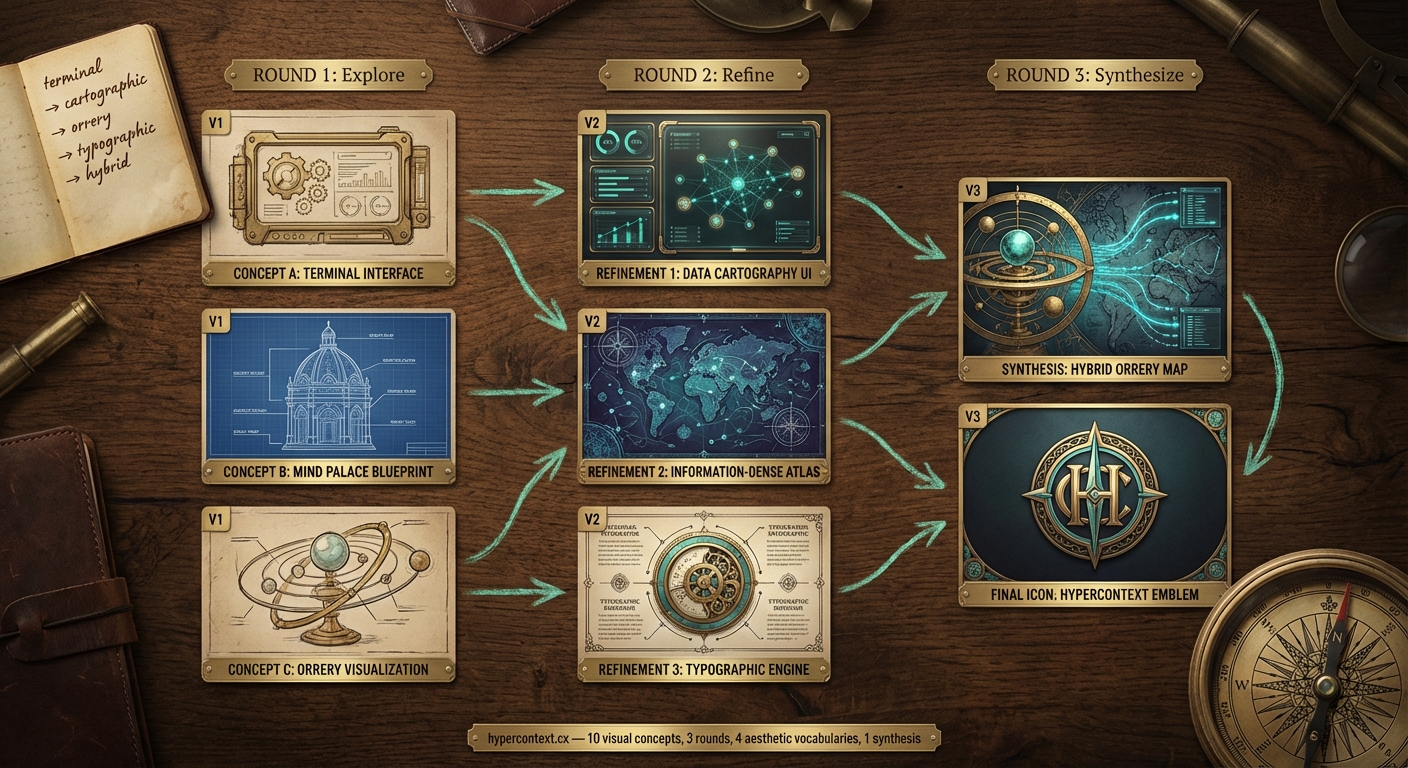
Round 1 — Explore: Four divergent aesthetics generated in parallel. Terminal phosphor, cartographic territory, cognitive radar, Swiss typographic.
Round 2 — Refine: Cross-pollinated the strongest elements. Territory map got labeled volcanoes, orrery got real workstream planets, the hybrid merged radar + territory, typographic got real data.
Round 3 — Synthesize: Cinematic poster, brand icon (three rings), social card.
Round 4 — Meta: This making-of image. A hypercontext map of the hypercontext visual development process. Recursive.
All visuals generated by Gemini 3 Pro. Two instances per round — "beating against yourself" to evolve vocabulary.
         }@{@}@{@}@{@}
       @{@}@{@}@{@}@{@}@{
      @}@{@}@{@}@{@}@{@}@{@}
     @{@}@@@@@@@@@@@@@@@@{@}@{
     @@@@@                @@@@@
     @@  ┌──────┐ ┌──────┐  @@
     @@  │  ·   │─│  ·   │  @@   "curls get claudes
     @@  └──────┘ └──────┘  @@    with skills"
      @@        /\         @@
       @\      ‾‾‾‾       /@
         `-.    ||    .-'
              `'||`'